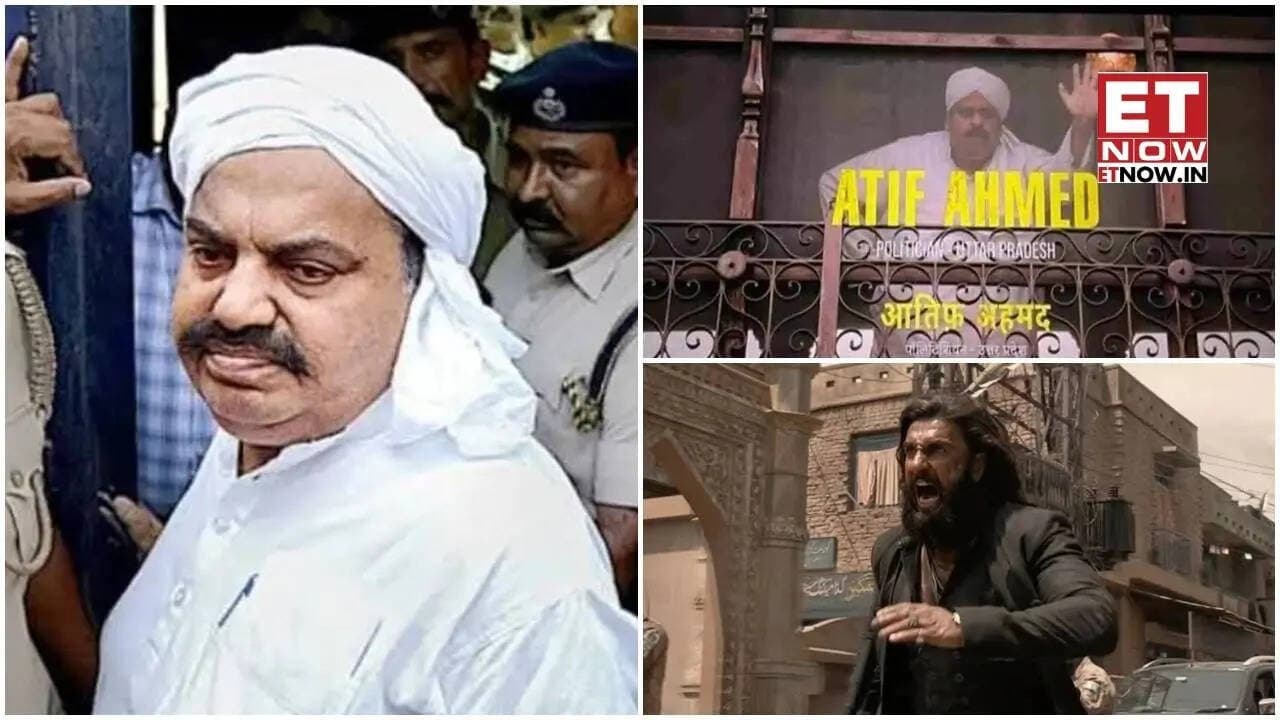
Who was Atiq Ahmed? Shot dead in front of cameras — How Dhurandhar uncovers his fake money empire, terror ties and the real reason behind the killing
Who was Atiq Ahmed: Atiq Ahmed was not just another gangster from Uttar Pradesh—he was, for decades, a system within the system. Born in 1962 in Prayagraj (then Allahabad), he rose from modest beginnings to become one of North India’s most feared and politically influential strongmen. By the time of his death in April 2023, he had built a reputation that blurred the lines between crime, politics and power in a way few others had managed. His journey began early. At just 17, he was accused in a murder case in 1979. By 1983, his first FIR marked the beginning of a long criminal record that would eventually span over 100 cases, including murder, extortion, kidnapping and land grabbing. But what made Ahmed different was not just the scale of his crimes—it was how seamlessly he converted fear into legitimacy. In 1989, he contested elections from Allahabad West and won. That victory changed everything. He went on to become a five-time MLA and later a Member of Parliament from Phulpur in 2004—a seat once represented by Jawaharlal Nehru. His rise symbolised a dangerous but familiar Indian reality: the transformation of a “bahubali” into a lawmaker. Who was Atiq Ahmed: The Live TV Killing That Shocked India On April 15, 2023, India witnessed one of its most chilling real-time crimes. Atiq Ahmed and his brother Ashraf were being escorted by police in Prayagraj for a routine medical examination when three men posing as journalists stepped forward. Within seconds, chaos unfolded. As Ahmed began speaking to the media, shots rang out at point-blank range. The attackers—Lavlesh Tiwari, Arun Maurya and Sunny—fired multiple rounds before surrendering immediately. The entire incident was broadcast live, leaving the country stunned. The timing added another layer of intensity. Just two days earlier, Ahmed’s son, Asad Ahmed, had been killed in a police encounter in Jhansi in connection with the Umesh Pal murder case. It felt less like coincidence and more like the closing chapter of a long, violent saga. Who was Atiq Ahmed: From Ganglord to Political Power Centre Atiq Ahmed’s real strength lay in his ability to operate beyond prison walls. Even while incarcerated, he reportedly continued to run his network, influence contracts, manage land deals and control loyalists across Uttar Pradesh. Investigations by agencies such as the Enforcement Directorate revealed a sprawling financial empire: Over 200 bank accounts linked to associates and family membersAround 50 shell companies used to launder moneyDozens of benami properties worth hundreds of croresA steady flow of cash through extortion, land grabbing and illegal trade His influence extended into the real estate and construction sectors, where coercion often replaced negotiation. Businessmen, developers and even political rivals operated under the shadow of his network. This is where his persona became almost myth-like—someone who could “manage everything”, whether inside jail or outside. A line often associated with his portrayal in cinematic adaptations captures this perfectly: “Jab tak Atiq Ahmed hai — jail mein ya bahar… woh sab sambhal lega.”It wasn’t just dialogue—it reflected a widely held perception. Terror Links, Fake Money and Arms Networks While Ahmed’s criminal record was well documented, investigations also pointed towards a more dangerous dimension—his alleged links with cross-border terror networks. According to police charge sheets and reports: He admitted to connections with Pakistan’s ISI and Lashkar-e-TaibaWeapons were allegedly sourced via drone drops across the borderThese arms were used by his gang in high-profile killings, including the Umesh Pal caseHis network played a role in circulating illegal funds and managing unaccounted cashAlthough direct involvement in manufacturing counterfeit currency remains less clearly documented, authorities have repeatedly highlighted his role in illegal financial channels, including laundering and circulation of illicit funds. This intersection of organised crime and national security concerns is where the narrative becomes significantly more serious—and where cinematic interpretations have drawn sharp focus. How Aditya Dhar Reimagines the Story on Screen Filmmaker Aditya Dhar approaches this real-life saga not as a biographical retelling but as a layered political thriller rooted in truth. In his interpretation, Atiq Ahmed is not merely a gangster—he becomes a crucial node in a larger ecosystem of terror financing and cross-border destabilisation. Dhar uses the character to expose how: Fake currency flows weaken local economiesArms networks exploit porous systemsCrime syndicates become facilitators for anti-national operationsThe film pushes the idea that such figures are not isolated criminals but strategic assets in larger geopolitical games. By tying Ahmed’s operations to Pakistan-backed networks, Dhar amplifies the stakes—transforming a regional strongman into a national security threat. This creative choice, while cinematic, is grounded in investigative threads that have linked organised crime with terror logistics in certain cases. The Real Reason Behind His Killing The question that continues to divide public opinion is simple: why was Atiq Ahmed killed in such a dramatic, public manner? There are multiple interpretations. For some, it was inevitable. A man with over 100 criminal cases, accused in high-profile murders including that of BSP MLA Raju Pal and later Umesh Pal, had long been living on borrowed time. His own words from years ago now feel prophetic: “Sab ko pata hota hai anjaam kya hona hai…” For others, the killing raised uncomfortable questions about law and order. Was it justice, or a breakdown of due process? Did it signal the rise of mob-driven narratives over institutional accountability? But one perspective—often highlighted in cinematic retellings—is more strategic. If a figure like Ahmed was indeed embedded within networks that enabled terror logistics, then eliminating him would not just be about crime—it would be about dismantling a system. In that reading, his death becomes symbolic: removing a central figure to weaken a larger chain. Filmmakers like Aditya Dhar attempt to answer these through storytelling—connecting individual narratives to larger national concerns. Whether one agrees with these interpretations or not, one thing is certain: the story of Atiq Ahmed is far from over. It continues to provoke, unsettle and demand reflection.